The Quiet Work of a Root Cellar
A root cellar stores produce by matching its needs to cool, dark, steady conditions, with separate spaces for crops that prefer damp or dry air.
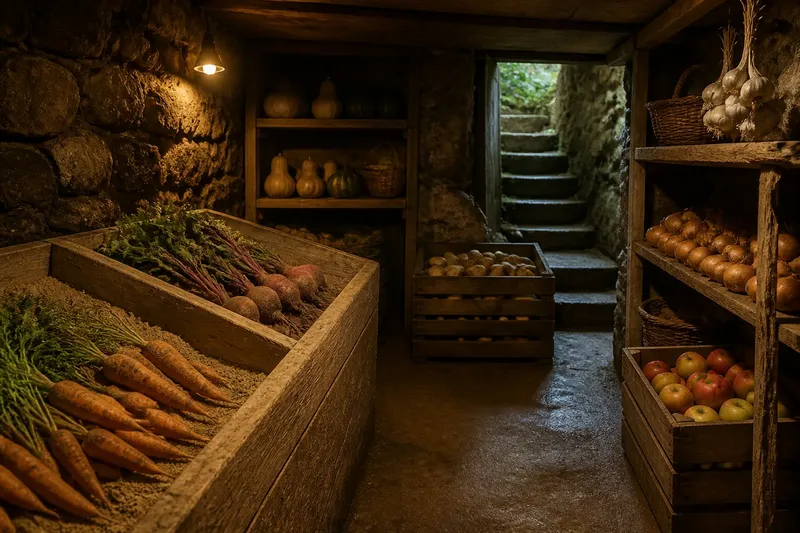
Why did a traditional root cellar have separate bins, shelves and corners instead of one open room? A root cellar kept food usable by matching each crop to the conditions it preferred: coolness, darkness and a steady environment, with moisture and airflow adjusted by location. Its layout was practical sorting, built into the room.
What makes a root cellar different from an ordinary storeroom?
A root cellar uses the ground and the building around it to moderate temperature changes. Earth-covered walls, a shaded position or a space below the main floor could help keep conditions cooler and less changeable than a sunlit kitchen or shed.
Darkness mattered because light could encourage sprouting or green patches on some stored crops. The aim was not to make every corner identical. It was to make a protected place where food could wait without being exposed to bright light, warm rooms or rapid shifts in conditions.
Traditional cellars varied with local soil, building materials and climate. A cellar built into a hillside would behave differently from one beneath a house, and its doors, vents and interior partitions reflected those constraints. “Root cellar” describes a purpose, not a single standard design.
Why did different crops need different places?
Stored produce does not all respond in the same way to moisture and air. Some roots keep better in cool, humid conditions that limit shrivelling; other crops prefer drier surroundings, where dampness may encourage decay. A cellar’s layout separated these needs rather than asking one setting to suit everything.
Carrots, beetroots and similar roots were often kept in bins or packed with suitable material to help retain moisture. Potatoes needed darkness and cool conditions, but a pile also needed enough air movement to avoid stale, damp pockets. The exact arrangement depended on the crop and the cellar.
Onions and garlic, by contrast, were commonly kept in a drier, airy place after curing. Putting them beside damp roots could undermine their keeping quality. Apples also benefited from their own space, since bruised or deteriorating fruit could affect nearby produce and its smell could travel through a crowded room.
The partitions therefore reflected differences that a household could notice by handling the food: a root that had gone limp, an onion that felt damp, or a potato beginning to sprout. Separate zones made those changes easier to spot and reduced needless disturbance of everything else.
How did a cellar control dampness and airflow?
Ventilation helped move stale air and excess moisture, while the cellar’s earth and structure helped buffer conditions outside. Traditional designs might use vents or small openings, but their position and use depended on the building and local weather. Air movement was a tool to manage, not a reason to leave every opening wide.
Too much dry air could draw moisture from roots; persistent dampness could favour mould or rot. A household might therefore place moisture-sensitive crops in different corners, use bins or shelves to keep them apart, and adjust ventilation with the season. The layout made those small adjustments possible.
Containers also mattered. A slatted crate allowed more air to pass through than a tightly closed box, while a bin with packed roots held a more humid pocket. These were not interchangeable choices: the container suited the crop, and the crop’s condition guided where it belonged.
In a modern home, do not assume a garage, basement or cupboard behaves like a traditional cellar. Check the actual conditions with a thermometer and, if useful, a humidity meter; observe condensation, odours and changes in the produce. Follow the food label and manufacturer instructions where relevant, and local rules where they apply.
What did the cellar’s layout say about household habits?
A cellar was organised around use as well as preservation. Food needed to be reachable when meals were prepared, but a frequently opened door could disturb the calmer conditions deeper inside. Shelves and bins helped distinguish what was ready to eat from what was being held back.
Produce was often stored in a form that made inspection and rotation straightforward. A shallow shelf suited items that should not be crushed; a deeper bin could hold a larger quantity of robust roots. Keeping different foods apart also helped people notice a soft or damaged item before it affected its neighbours.
Imagine a household with a cool, dark basement corner, a dry shelf near the stairs and a ventilated crate. It could keep potatoes in the dark crate, onions on the dry shelf and carrots in a separate, more humid bin; the expected observable result would be less mixing of smells and easier inspection of each crop. If the basement corner proved damp or warm, the household would need to change the arrangement rather than rely on the cellar’s name.
What questions do people ask about a root cellar?
Can I use a basement as a root cellar?
Possibly, if it stays cool, dark and reasonably steady, with a suitable place for the crops you intend to keep. A basement that is warm, bright, damp or strongly scented may not provide the right conditions, so assess the space before storing food there.
Why keep onions away from potatoes?
They suit different storage conditions: onions generally need a dry, airy place, while potatoes need darkness and can tolerate a more humid environment. Separation also helps keep their smells and any spoilage from affecting one shared pile.
Should stored vegetables be washed first?
That depends on the crop and how it is being stored. Soil can be brushed away from some roots, while washing adds surface moisture; follow crop-specific guidance and do not put wet produce into a space intended to stay dry.
How can I tell whether my storage spot is suitable?
Watch the food as well as the room: shrivelling, condensation, sprouting, soft patches or mould indicate that conditions or handling may need attention. A thermometer and humidity meter can add useful context, but the produce itself remains an important sign.
What is the cellar’s most useful lesson today?
The root cellar’s quiet work came from assigning each food a place, not from treating storage as a single setting. Coolness and darkness formed the broad protection; bins, shelves, ventilation and separation responded to the differences between crops.
That principle still helps anyone deciding where food should wait: begin with what the produce needs, then choose a spot and container that suit it. A cellar is only useful when its layout makes those needs visible and manageable.